


We’re leaving the Czech Republic today. We cycle from Mikulov to Mistelbach, Aus and then take a bus into Vienna. At 5 km we cross the border but would have never known it had our guide not paint “BORDER” on the pavement. We carried our passports because the authorities sometimes check due to the migrants. But we never saw an official of any type.
The farming country didn’t change when we changed countries. We did detect a couple of new crops, beets and potatoes.

At Mistelbach, the bike riding is over. We celebrate with pizza and many Radler’s, thankful that the ride is over. Brenda and I are thankful there were no major injuries. One person fell in a spa, one fell in the shower and a tandem couple fell on their bike but no one was seriously injured. So we board the bus for Vienna. Bikes go various directions depending whether they were rented or personally owned.
Vienna is the capital and largest city of Austria, and one of the nine states of Austria. Vienna is Austria's primary city, with a population of about 1.8 million (2.6 million within the metropolitan area, nearly one third of Austria's population), and its cultural, economic, and political centre. It is the 7th-largest city by population within city limits in the European Union. Until the beginning of the 20th century, it was the largest German-speaking city in the world, and before the splitting of the Austro-Hungarian Empire in World War I the city had 2 million inhabitants. Today it has the second largest number of German speakers after Berlin. Vienna is host to many major international organizations, including the United Nations and OPEC. The city is located in the eastern part of Austria and is close to the borders of the Czech Republic, Slovakia, and Hungary.
Vienna is also where Brenda and I spent our tenth anniversary. Today, and for the next 3 days, we are staying in the Stefanie hotel, the city’s oldest. I remember the opening. Very nice digs.

We get views of Znojmo as we leave town, putting the place in a different perspective. Photo on right below by Patrice Van Vleet.
Today is our penultimate riding day and the last day and night in the Czech Republic. It’s been a great ride. Mikulov is an important border town on the ancient “Amber Road” from the Baltic Sea to the Adriatic. When the Austrian Kings expelled Jews from Austria in the early 1400’s, they settled here on the border, gradually making up half of the town’s population and forming the largest Jewish population in the Czech Republic outside of Prague.
We are staying in the Jewish quarter. The restaurant menu has a puzzling title “Jewish Menue or what used to be eaten in this house”. Ok, I now know what that means: Brenda learned there are no longer any Jews living in Mikulov. We visited the Synagogue:


Mikulov is in the center of Moravia which means its in the center of Czech wine. Before lunch we were briefly on a busy road. All busy roads are very smooth. There were big farm trucks on the road; they gave us wide berth when passing so we were never frightened.
After lunch, and almost all afternoon, we were on a single lane road through the farms. We saw cabbage, clover, corn, mustard, orchards, peppers, pumpkin, tomatoes, a tree farm (olive trees?), vineyards and wheat. Photo on right below by John Harvey.

Wikepedia gives us some information, probably more than you want:
Znojmo (Czech pronunciation: [ˈznojmo]; German: Znaim) is a town in the South Moravian Region of the Czech Republic, the administrative capital of the Znojmo District.
The town is situated on a rock outcropping on the steep left bank of the Thaya (Dyje) River, about 55 km (34 mi) southwest of the regional capital Brno. Located near the border with Austria, it is connected to Vienna by railway and road (about 80 minutes).
There were three long paragraphs of the history of Znojmo on Wikepedia but I deleted them rather than bore you – even if this is the “boring blog”.
As we left Vranov along the lake we spotted a contemporary bridge. I thought we were going over it but our path changed and we rode around the lake.
A detour at km 10 took us to the only remaining section of the Iron Curtain in the Czech Republic. Originally 7250 km in length, from the Baltic Sea to the Adriatic Sea, of which 963 km lay in Czechoslovakia. (see phoho on right below) Today there are no border crossings between EU countries – it’s just like driving from Oklahoma to Texas, without the welcome signs.


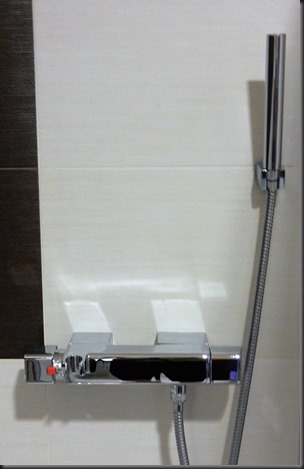
Some of these hotels are amazing. They may be in an old building but most have very contemporary furnishings. Below shower head, railing, table lamp.


Znojmo is a lively town of 20,000 – the size of Fredericksburg, TX and Frisco, CO combined.
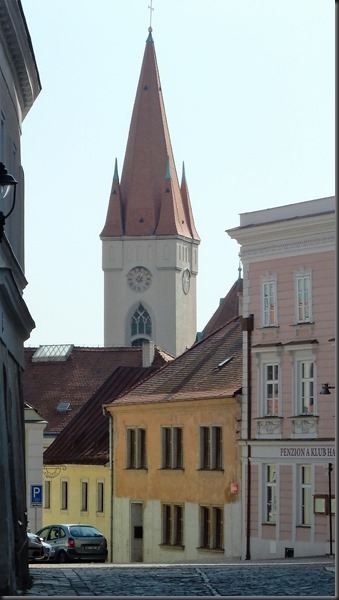

Today’s destination, Vranov (and Monday’s destination of Znojmo) are so small that Rick Steves doesn’t even mention them. So where am I going to get the stuff I usually tell you about? Make it up? Again?
As soon as I wrote the last sentence an idea occurred: Wikipedia, the source of all knowledge. Oops, it didn’t have Vranov as a topic, only the following “Vranov is a village and municipality (obec) in Brno-Country District in the South Moravian Region of the Czech Republic. In 2006 the population was 639. And there is a graveplace of the Dukes of Liechtenstein here.” Not much to write home about. And it didn’t tell me about the castle! A big one at the top of the hill. But surely I’ve seen enough castles for this trip. Another concern, what type of hotel will there be in this tiny town. Well, below you’ll see the castle and the very nice hotel.

So maybe we can talk about the weather. It has been, and will continue to be, unseasonable hot. A high of 80 degrees is probably 10 degrees over the expected. Milada told us that recent winters have been unusually mild with no snow. Global warming, CZ.
I’ve wondered about the difference between a castle and a chateau. It appears that castles are almost always fortified whereas a chateau may or may not be fortified. They’re more of a country house or manor for nobility or gentry. Also, according to Wikipedia, chateaus are primarily in France or French-speaking regions.
And what is a “bohemian”? Well for sure it’s someone from Bohemia, a part of the Czech Republic. (The part we just left; we’re now in Moravia, the wine producing region) In a separate meaning derived from the French word referring to "gypsies," or Romani people, "Bohemian" may also denote "a socially unconventional person, especially one who is involved in the arts". Hmmm. Is writing a blog art? Then maybe I’m Bohemian, because the rest of the definition certainly fits.
Today’s ride was supposed to be easy; I didn’t think so. Sometime after lunch, going up another hill Brenda remarked “Czechoslovakia sure is hilly.” Of course she misspoke since Czechoslovakia was dissolved into the Czech Republic and Slovakia on 1 January 1993. From all I can tell the Czech Republic is more prosperous than Slovakia.
We knew that Prague was prosperous with it’s 1.2% unemployment. But what about the rest of the country? Would we find prosperity or poverty in the rest of the country?

We found the countryside, the small villages and the farms to be in great shape. No deteriorated buildings – no dying cities like you’ll find in West Texas. Prosperity obviously encompasses the entire country of the Czech Republic.
Thought for the day:
“Any country in which the beer is cheaper than the water, has got to be a great country!”
Telc (pronounced “telch”, population 6,000) is famous for it’s glorious square, considered by many to be the country’s finest. The general lay of the land has changed little since the 1300’s. This is the third of four UNESCO World Heritage Villages on this tour. Thanks to Patrice for the photo on the left below.

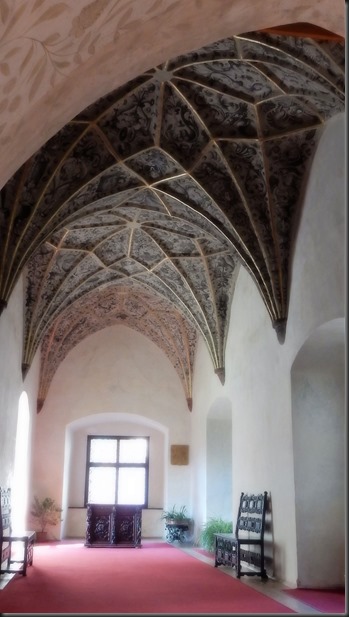
We had a guided tour of Telc Castle this morning. Like most castles and chateaus we’ve visited this belonged to the clan of the Five Roses. In the 1500’s an imported team of Italian artists turned the earlier Gothic palace into a lavish Renaissance residence. For once, photos were allowed – enjoy them.




Although Telc seems like a sleepy little town, it was a hub of activity today (Saturday). There is a (small) Farmers Market in the square, a charity bike ride (many cyclists in costumes) and an afternoon concert in one of the churches.


And I can’t end the blog without a picture of every male cyclist’s favorite tour guide. And we don’t even remember her name.
Today was supposed to be our longest and hardest day. It was the longest but not the hardest day. We may have climbed more than other days but there were no impossible climbs. It couldn’t have been too hard; we were at the hotel by 3:00.
In the communist era, the Russians built a one lane road along the Austrian border; this was for military vehicles only. Today, it makes a great bike path. Thanks, commies. We were in the forest most of the morning. The thirty kilometer climb was a non event. In the afternoon we were in farmland.


I think is was about 35 km where we stopped for gelato. At 50 km, we had a picnic lunch.

Late in the afternoon, maybe 10 km from Telc, our route detoured to a monestary. I believe the name of is was Svata Brana.
Today’s destination, Telc, is another UNESCO town in the southwest corner of the Bohemian-Moravian highlands. It is near an ancient provincial route from Vienna to Prague – exactly at the midpoint. We’re here for town tomorrow and will have a guided tour of the castle so I’ll talk about the town then.


